Código y Código de Ética
Por
Angel R. Cepeda Dovala y Juan Manuel Cepeda Dovala
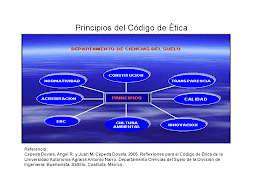
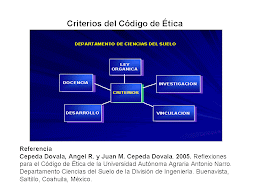
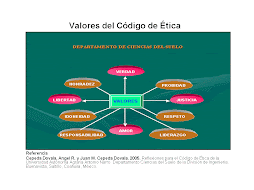
Un Código, entendido como conjunto de leyes, según un plan metódico y sistemático, tiene distintas orientaciones, puede decirse, que etimológicamente es una palabra que proviene del latín Codex, Codicis, libros, y también en su aspecto actual podríamos definirla como un conjunto de normas jurídicas; pero también los términos juntos: “Código de Ética”, es El conjunto de normas de los valores humanos que permiten regular y mejorar la vivencia y convivencia.
Se deben considerar cuatro aspectos desde el punto de vista metodológico para su comprensión: Principios, Criterios, Valores, y Virtudes, entonces la propuesta de este trabajo, también los incluye.
Referencia:
Cepeda Dovala, Angel R. y Juan M. Cepeda Dovala. 2005. Reflexiones para el Código de Ética de la Universidad Autónoma Agraria Antonio Narro. Departamento Ciencias del Suelo de la División de Ingeniería. Buenavista, Saltillo, Coahuila, México (ISBN 968-844-040-X)Cf. Cap. 2, p 11
domingo, 9 de septiembre de 2007
sábado, 8 de septiembre de 2007
The Scientific Method and the Meaning of the Scientific Hypothesis
The Scientific Method and the Meaning of the Scientific Hypothesis
By
Angel Rumualdo Cepeda Dovala
Juan Manuel Cepeda Dovala
José Luis Cepeda Dovala
Ignacio Garnica Dovala
José Angel Cepeda Ballesteros
Sonia Margarita Cepeda Ballesteros
Sonia Ballesteros Quintero
ABSTRACT. The Scientific Method is the way that continues in a process of investigation and the Hypothesis are the scientific suppositions and they represent the conductive thread to resolve a problem presented. Many Methods exist (Polymethod), many sciences (Polyscience) and many Techniques (Polytechnic), where the hypothesis they can be: math, statistics, Probabilistic, Not math, and diagrammatic. Inside the Statistics Methods, different Experimental Designs exist, represented through Models: Regression and Correlation, Completely Random Design, Factorials Experiments, and others. To each one of these models they will correspond certain type of hypothesis and its Analysis of Variance. This essay contemplates three examples of Hypothesis: 1. Considering Statistics, Mathematics and Probabilistic Methods; 2. Without considering this math’s Methods; and, 3. Diagrammatic Hypothesis. In the Hypothesis of the example 1, seven situations of hypothesis were undertaken (A to G). We are mentioned the Completely Random Design whose lineal model is: Yij = μ + τi + εij ; where εij ~ NI(0,σ2), that is to say, the experimental error is distributed normally independent, with mean zero (μ = 0) and variance σ2. This it is one of the models less costly with learning teaching end, but should be considered that different Probabilistic Models exist: Discrete and Continuous, and the variables of study can be continuous and discrete, for which in the approach of the hypothesis and its analysis one must consider these situations. In the examples of hypothesis 2 and 3, the first one represents an original contribution and in the second they are the diagrammatics hypothesis presented by J. Watson, one of the discoverers of the Structural Model of the Double Helix: DNA (Acid Deoxyribonucleic), fundaments of the modern Biotechnology in the Agricultural Sciences and Soil Sciences.
Key Word: Agricultural, Biotechnology, Continuous, Discrete, DNA, Science(s), Statistic(s), Deoxyribonucleic, Mathematic, Polyscience, Polymethod, Polytechnic, Probabilistic, Soil Sciences.
By
Angel Rumualdo Cepeda Dovala
Juan Manuel Cepeda Dovala
José Luis Cepeda Dovala
Ignacio Garnica Dovala
José Angel Cepeda Ballesteros
Sonia Margarita Cepeda Ballesteros
Sonia Ballesteros Quintero
ABSTRACT. The Scientific Method is the way that continues in a process of investigation and the Hypothesis are the scientific suppositions and they represent the conductive thread to resolve a problem presented. Many Methods exist (Polymethod), many sciences (Polyscience) and many Techniques (Polytechnic), where the hypothesis they can be: math, statistics, Probabilistic, Not math, and diagrammatic. Inside the Statistics Methods, different Experimental Designs exist, represented through Models: Regression and Correlation, Completely Random Design, Factorials Experiments, and others. To each one of these models they will correspond certain type of hypothesis and its Analysis of Variance. This essay contemplates three examples of Hypothesis: 1. Considering Statistics, Mathematics and Probabilistic Methods; 2. Without considering this math’s Methods; and, 3. Diagrammatic Hypothesis. In the Hypothesis of the example 1, seven situations of hypothesis were undertaken (A to G). We are mentioned the Completely Random Design whose lineal model is: Yij = μ + τi + εij ; where εij ~ NI(0,σ2), that is to say, the experimental error is distributed normally independent, with mean zero (μ = 0) and variance σ2. This it is one of the models less costly with learning teaching end, but should be considered that different Probabilistic Models exist: Discrete and Continuous, and the variables of study can be continuous and discrete, for which in the approach of the hypothesis and its analysis one must consider these situations. In the examples of hypothesis 2 and 3, the first one represents an original contribution and in the second they are the diagrammatics hypothesis presented by J. Watson, one of the discoverers of the Structural Model of the Double Helix: DNA (Acid Deoxyribonucleic), fundaments of the modern Biotechnology in the Agricultural Sciences and Soil Sciences.
Key Word: Agricultural, Biotechnology, Continuous, Discrete, DNA, Science(s), Statistic(s), Deoxyribonucleic, Mathematic, Polyscience, Polymethod, Polytechnic, Probabilistic, Soil Sciences.

Significado de las palabras Polis y Poli
Significado de las palabras Polis y Poli
Por
Angel R. Cepeda Dovala
Polis en plural y Poli en singular, provienen del griego y significan ciudad, pero también tiene el significado de “muchos” o “muchas” como es el caso del Politécnico o la Politécnica (Muchas Técnicas), las palabras novedosas y originales son Polimétodo (Muchos métodos), Policiencia (Muchas ciencias) y Polilógica (Muchas Lógicas). El término de Polilógica se refiere al conocimiento verdadero visto con distintos criterios: Lógica, Formal, Lógica Simbólica, Lógica Matemática, Lógica Dialéctica, por mencionar algunas de los distintos tipos de Ciencia Lógica.
Referencia:
Cepeda Dovala, Angel R. 2005. De Mendel a Watson y Crick, 50 años después. N° 3. Segunda edición. Tópicos Culturales AΩ, en coedición con la Universidad Autónoma Agraria Antonio Narro, Dirección de Investigación y Departamento Ciencias del Suelo. A.R.C.D. Editor. D. F. (Libro 172 p. DR©; ISBN 970-9341-1-0) Cf. p 52.
Por
Angel R. Cepeda Dovala
Polis en plural y Poli en singular, provienen del griego y significan ciudad, pero también tiene el significado de “muchos” o “muchas” como es el caso del Politécnico o la Politécnica (Muchas Técnicas), las palabras novedosas y originales son Polimétodo (Muchos métodos), Policiencia (Muchas ciencias) y Polilógica (Muchas Lógicas). El término de Polilógica se refiere al conocimiento verdadero visto con distintos criterios: Lógica, Formal, Lógica Simbólica, Lógica Matemática, Lógica Dialéctica, por mencionar algunas de los distintos tipos de Ciencia Lógica.
Referencia:
Cepeda Dovala, Angel R. 2005. De Mendel a Watson y Crick, 50 años después. N° 3. Segunda edición. Tópicos Culturales AΩ, en coedición con la Universidad Autónoma Agraria Antonio Narro, Dirección de Investigación y Departamento Ciencias del Suelo. A.R.C.D. Editor. D. F. (Libro 172 p. DR©; ISBN 970-9341-1-0) Cf. p 52.
Sobre la Politécnica, Polimétodo, Policiencia, y Polilógica
Sobre la Politécnica, Polimétodo, Policiencia, y Polilógica
Por
Angel R. Cepeda Dovala
Planteamiento del problema: Desde tiempos remotos, el hombre se ha planteado la necesidad de tener una Concepción del Mundo y del Universo, por lo que se ha manifestado en todos los pueblos y diferentes culturas y civilizaciones, de distintas épocas; de tal forma, que podemos observar que siempre se ha tendido a una objetivación de esta Concepción, surgen con sus creencias, un conocimiento de la realidad el cual a venido cambiando con la aparición de la Técnica, el desarrollo de la Ciencia, su Lógica y su Método, en distintos campos del saber.
Hipótesis: En realidad no hay un Método único, una Técnica, ni Ciencia exclusiva, y por lo tanto, ni Técnicas, ni Métodos y Ciencias para la concepción del mundo y del universo: esta es una Hipótesis; por lo que a continuación se plantea la siguiente:
Tesis: Han existido tantos tipos de creencias, lógicas, técnicas, ciencias, métodos, que tratan de ver al mundo y al universo en su conjunto en un plano ideal, material, subjetivo, objetivo, o fusionados unos con otros, propuestos por el paradigma viviente y pensante y racional que es el hombre y la mujer, en su sentido genérico: Homo sapiens.
Antítesis: La historia nos ha dicho que no a prevalecido uno más que otro, en cuanto al conocimiento se refiere, debido a la dinámica y el desarrollo de la cultura y civilización, así como al surgimiento de nuevos conceptos, definiciones, lenguajes, costumbres, técnicas, métodos y ciencias.
Síntesis: La POLITÉCNICA, el POLIMÉTODO y la POLICIENCIA, con el apoyo de la POLILÓGICA, íntimamente interrelacionados o multirelacionados, pudieran ser la nueva piedra fundamental para reordenar el conocimiento, con la Dimensión del Monoteísmo Cristiano, tomando como fundamento la Fe y la Razón, o bien, considerando el trinomio: Razón, Libertad y Verdad, que repercuta en el Bien Común de toda la Sociedad.
Cortesía de Tópicos Culturales AΩ. A.R.C.D. Editor
Referencia:
Cepeda Dovala, Angel R. 2005. De Mendel a Watson y Crick, 50 años después. N° 3. Segunda edición. Tópicos Culturales AΩ, en coedición con la Universidad Autónoma Agraria Antonio Narro, Dirección de Investigación y Departamento Ciencias del Suelo. A.R.C.D. Editor. D. F. (Libro 172 p. DR©; ISBN 970-9341-1-0) Cf. Cuadro 6, p 52.
Por
Angel R. Cepeda Dovala
Planteamiento del problema: Desde tiempos remotos, el hombre se ha planteado la necesidad de tener una Concepción del Mundo y del Universo, por lo que se ha manifestado en todos los pueblos y diferentes culturas y civilizaciones, de distintas épocas; de tal forma, que podemos observar que siempre se ha tendido a una objetivación de esta Concepción, surgen con sus creencias, un conocimiento de la realidad el cual a venido cambiando con la aparición de la Técnica, el desarrollo de la Ciencia, su Lógica y su Método, en distintos campos del saber.
Hipótesis: En realidad no hay un Método único, una Técnica, ni Ciencia exclusiva, y por lo tanto, ni Técnicas, ni Métodos y Ciencias para la concepción del mundo y del universo: esta es una Hipótesis; por lo que a continuación se plantea la siguiente:
Tesis: Han existido tantos tipos de creencias, lógicas, técnicas, ciencias, métodos, que tratan de ver al mundo y al universo en su conjunto en un plano ideal, material, subjetivo, objetivo, o fusionados unos con otros, propuestos por el paradigma viviente y pensante y racional que es el hombre y la mujer, en su sentido genérico: Homo sapiens.
Antítesis: La historia nos ha dicho que no a prevalecido uno más que otro, en cuanto al conocimiento se refiere, debido a la dinámica y el desarrollo de la cultura y civilización, así como al surgimiento de nuevos conceptos, definiciones, lenguajes, costumbres, técnicas, métodos y ciencias.
Síntesis: La POLITÉCNICA, el POLIMÉTODO y la POLICIENCIA, con el apoyo de la POLILÓGICA, íntimamente interrelacionados o multirelacionados, pudieran ser la nueva piedra fundamental para reordenar el conocimiento, con la Dimensión del Monoteísmo Cristiano, tomando como fundamento la Fe y la Razón, o bien, considerando el trinomio: Razón, Libertad y Verdad, que repercuta en el Bien Común de toda la Sociedad.
Cortesía de Tópicos Culturales AΩ. A.R.C.D. Editor
Referencia:
Cepeda Dovala, Angel R. 2005. De Mendel a Watson y Crick, 50 años después. N° 3. Segunda edición. Tópicos Culturales AΩ, en coedición con la Universidad Autónoma Agraria Antonio Narro, Dirección de Investigación y Departamento Ciencias del Suelo. A.R.C.D. Editor. D. F. (Libro 172 p. DR©; ISBN 970-9341-1-0) Cf. Cuadro 6, p 52.
jueves, 6 de septiembre de 2007
Significado de las Hipótesis Científicas
Significado de las Hipótesis Científicas
Por
Angel R. Cepeda Dovala
La Hipótesis, en singular y en plural, representan el hilo conductor de toda la investigación, y estas son suposiciones científicas, las cuales pueden ser enunciadas en forma: afirmativa, negativa, interrogativa, negativa interrogativa y afirmativa interrogativa, y también pueden representarse a través de una figura o diagrama, para ilustrar mejor, adonde se quiere llegar.
Y, en base a estas suposiciones, se plantean los objetivos de investigación y los métodos (matemáticos, estadísticos, genéticos, inductivos, deductivos, etc.) para comprobar las hipótesis y llegar a una conclusión; o bien, si usted emplea el Método Dialéctico, después de Plantear un Problema y la Hipótesis, puede presentar la: Tesis, Antitesis y la Síntesis, procedimientos metodológicos conocidos por Sócrates, Platón, Aristóteles, y muchas otras Personas de Ciencia y Sabiduría. ¿Por qué?
Porque las Hipótesis surgieron en las Ciencias Matemáticas, en particular en la Geometría, de ahí pasaron a la Filosofía y demás Ciencias Sociales y Filosóficas, y luego a las Ciencias Naturales.
Del anterior significado de las Hipótesis, se desprende qué deben ser científicas, por lo que no cualquier suposición, conjetura o especulación es una Hipótesis Científica, entonces ellas, conservan en sí, características de predicción sin perder su valor hurístico en el desarrollo científico, y en base a su aceptación o rechazo de las mismas, nos llevan a formular nuevas hipótesis, hasta llegar a: reglas, leyes, o principios, por ejemplo: Los Principios de la Herencia de Mendel o el Principio de que el Gen = ADN, es la unidad básica de la Herencia en el ser vivo.
Cortesía de Tópicos Culturales AΩ. A.R.C.D. Editor
Referencia:
Cepeda Dovala, Angel R. 2005. De Mendel a Watson y Crick, 50 años después. N° 3. Segunda edición. Tópicos Culturales AΩ, en coedición con la Universidad Autónoma Agraria Antonio Narro, Dirección de Investigación y Departamento Ciencias del Suelo. A.R.C.D. Editor. D. F. (Libro 172 p. DR©; ISBN 970-9341-1-0)Cf. Cuadro 5, p 50.
Por
Angel R. Cepeda Dovala
La Hipótesis, en singular y en plural, representan el hilo conductor de toda la investigación, y estas son suposiciones científicas, las cuales pueden ser enunciadas en forma: afirmativa, negativa, interrogativa, negativa interrogativa y afirmativa interrogativa, y también pueden representarse a través de una figura o diagrama, para ilustrar mejor, adonde se quiere llegar.
Y, en base a estas suposiciones, se plantean los objetivos de investigación y los métodos (matemáticos, estadísticos, genéticos, inductivos, deductivos, etc.) para comprobar las hipótesis y llegar a una conclusión; o bien, si usted emplea el Método Dialéctico, después de Plantear un Problema y la Hipótesis, puede presentar la: Tesis, Antitesis y la Síntesis, procedimientos metodológicos conocidos por Sócrates, Platón, Aristóteles, y muchas otras Personas de Ciencia y Sabiduría. ¿Por qué?
Porque las Hipótesis surgieron en las Ciencias Matemáticas, en particular en la Geometría, de ahí pasaron a la Filosofía y demás Ciencias Sociales y Filosóficas, y luego a las Ciencias Naturales.
Del anterior significado de las Hipótesis, se desprende qué deben ser científicas, por lo que no cualquier suposición, conjetura o especulación es una Hipótesis Científica, entonces ellas, conservan en sí, características de predicción sin perder su valor hurístico en el desarrollo científico, y en base a su aceptación o rechazo de las mismas, nos llevan a formular nuevas hipótesis, hasta llegar a: reglas, leyes, o principios, por ejemplo: Los Principios de la Herencia de Mendel o el Principio de que el Gen = ADN, es la unidad básica de la Herencia en el ser vivo.
Cortesía de Tópicos Culturales AΩ. A.R.C.D. Editor
Referencia:
Cepeda Dovala, Angel R. 2005. De Mendel a Watson y Crick, 50 años después. N° 3. Segunda edición. Tópicos Culturales AΩ, en coedición con la Universidad Autónoma Agraria Antonio Narro, Dirección de Investigación y Departamento Ciencias del Suelo. A.R.C.D. Editor. D. F. (Libro 172 p. DR©; ISBN 970-9341-1-0)Cf. Cuadro 5, p 50.
Demonic Affliction or Demonic Possession
SHORT COMUNICATION 9
Demonic Affliction or Demonic Possession
By
Roger Behra, B. S. Education *
* Bachelor of Science in Elementary Education, Western New Mexico University,
Silver City, New Mexico. He took five courses, 15 graduate hours, University of Arizona in Tucson, Arizona. 19 years experience teaching language arts in Arizona and Ohio, U.S.A. 10 years teaching religion in St. Ann Catholic School in Ohio, in addition.
Because we let evil enter our lives, demons can enter our lives also, and this can happen in two separate ways. A person can be demon afflicted or demonically possessed. Whether a person is afflicted or possessed, deliverance is absolutely necessary. In the case of being demoniacally possessed this requires an exorcism by an exorcist appointed by a Catholic Bishop. The exorcist priest follows an approved ritual and must be careful when performing an exorcism. The most successful exorcisms are the result of Catholic priests performing them.
A person, young or old, needing an exorcisms is referred only after extensive medical treatment has been done by qualified medical people and psychologist and psychiatrist. When behavior defies responding to regular medical treatment or psychological treatment, the indication is there is demonic expression present.
Demonic expression can take the form of merely affliction or very serious possession. Affliction means a person decides to do evil things. Possession means a person actually decides to let a demon enter his/her life and control behavior. It’s an agreement, consciously made, for one reason or another. The two kinds of demonic possession are: imperfect possession (can be exorcised) and perfect possession (can not be exorcised), and only an exorcism can determine which is the case.
The demon can be either male (called incubus) or female (called succubus). It is possible for more than one demon to afflict or possess a single person. Every demon has a name. Some demons depart easily. Some demons fight expulsion for hours. In the case of multiple demons an exorcism can take several days as longer. Perfect possession means the demon(s) can not be exorcised. A demon or demons can inhabit a house, which makes exorcism necessary to rid the house of it or them.
Individual persons bear the responsibility for the affliction or possession. They invited it into their lives. They made a deal with demonic evil, let evil enter their lives and control them. And later they regret it and seek help to eliminate it.
A definitive sign of demonic expression occurs when a person can not on his/her own eliminate the evil behavior or circumstances, and a professional person or persons must be needed. In the case of persons, when it is noticed, “a look in the eyes, a tone of voice, a sense of contempt, coldness, fits of suitable anger, and very smooth, taut facial expression are exhibited, you have the indication that a person is in league whit the devil”, says Father Malachi Martin, who was a world famous priest exorcist. And it is the priest exorcist who is the deciding factor whether it is demonic affliction or demonic possession.
If a demon takes only partial control (demonic affliction or imperfect possession) and the person wants to rid his life of its control, the person must consent to it and agree to an exorcism. It will not automatically, happen, and it is the only course to take. If a person is totally controlled (perfect possession) that person can not be helped, and an exorcism, if tried, is an unsuccessful adventure. In cases of perfect possession the exorcist priest usually knows ahead of time and does not attempt exorcism. When a person deliberately and consciously agrees to let the devil have his soul in exchange, he can not be helped. Sooner or later Satan will exact his price, and that will be the ownership of the person’s soul for all eternity.
“Demonic affliction and demonic possession have increased eight-hundred to a thousand percent since the 1970’s”, says father Martin. “We can see the effects all around and mostly in United States of America. It is a very serious matter in our daily lives in our modern world”.
Demonic Affliction or Demonic Possession
By
Roger Behra, B. S. Education *
* Bachelor of Science in Elementary Education, Western New Mexico University,
Silver City, New Mexico. He took five courses, 15 graduate hours, University of Arizona in Tucson, Arizona. 19 years experience teaching language arts in Arizona and Ohio, U.S.A. 10 years teaching religion in St. Ann Catholic School in Ohio, in addition.
Because we let evil enter our lives, demons can enter our lives also, and this can happen in two separate ways. A person can be demon afflicted or demonically possessed. Whether a person is afflicted or possessed, deliverance is absolutely necessary. In the case of being demoniacally possessed this requires an exorcism by an exorcist appointed by a Catholic Bishop. The exorcist priest follows an approved ritual and must be careful when performing an exorcism. The most successful exorcisms are the result of Catholic priests performing them.
A person, young or old, needing an exorcisms is referred only after extensive medical treatment has been done by qualified medical people and psychologist and psychiatrist. When behavior defies responding to regular medical treatment or psychological treatment, the indication is there is demonic expression present.
Demonic expression can take the form of merely affliction or very serious possession. Affliction means a person decides to do evil things. Possession means a person actually decides to let a demon enter his/her life and control behavior. It’s an agreement, consciously made, for one reason or another. The two kinds of demonic possession are: imperfect possession (can be exorcised) and perfect possession (can not be exorcised), and only an exorcism can determine which is the case.
The demon can be either male (called incubus) or female (called succubus). It is possible for more than one demon to afflict or possess a single person. Every demon has a name. Some demons depart easily. Some demons fight expulsion for hours. In the case of multiple demons an exorcism can take several days as longer. Perfect possession means the demon(s) can not be exorcised. A demon or demons can inhabit a house, which makes exorcism necessary to rid the house of it or them.
Individual persons bear the responsibility for the affliction or possession. They invited it into their lives. They made a deal with demonic evil, let evil enter their lives and control them. And later they regret it and seek help to eliminate it.
A definitive sign of demonic expression occurs when a person can not on his/her own eliminate the evil behavior or circumstances, and a professional person or persons must be needed. In the case of persons, when it is noticed, “a look in the eyes, a tone of voice, a sense of contempt, coldness, fits of suitable anger, and very smooth, taut facial expression are exhibited, you have the indication that a person is in league whit the devil”, says Father Malachi Martin, who was a world famous priest exorcist. And it is the priest exorcist who is the deciding factor whether it is demonic affliction or demonic possession.
If a demon takes only partial control (demonic affliction or imperfect possession) and the person wants to rid his life of its control, the person must consent to it and agree to an exorcism. It will not automatically, happen, and it is the only course to take. If a person is totally controlled (perfect possession) that person can not be helped, and an exorcism, if tried, is an unsuccessful adventure. In cases of perfect possession the exorcist priest usually knows ahead of time and does not attempt exorcism. When a person deliberately and consciously agrees to let the devil have his soul in exchange, he can not be helped. Sooner or later Satan will exact his price, and that will be the ownership of the person’s soul for all eternity.
“Demonic affliction and demonic possession have increased eight-hundred to a thousand percent since the 1970’s”, says father Martin. “We can see the effects all around and mostly in United States of America. It is a very serious matter in our daily lives in our modern world”.
miércoles, 5 de septiembre de 2007
What Happens During Exorcism
SHORT COMUNICATION 8
What Happens During Exorcism
By
Roger Behra, B. S. Education *
* Bachelor of Science in Elementary Education, Western New Mexico University, Silver City, New Mexico. He took five courses, 15 graduate hours, University of Arizona in Tucson, Arizona. 19 years experience teaching language arts in Arizona and Ohio, U.S.A. 10 years teaching religion in St. Ann Catholic School in Ohio, in addition.
Only one situation comes to mind that is worse than needing an exorcism, and it is denied or simply unavailable, and that is to die before one’s time because how one spends eternity is directly related.
Many outcomes of psychiatric therapy are referrals for exorcism. But not all referrals end in exorcism for one reason or another. A Bishop’s decision may be against exorcism. No exorcism exists nearby. A person may be perfectly possessed and, therefore, not exorciseable. But the exorcisms that do take place are extremely memorable, -never-to-be-forgotten episodes. That leads to the question –what happens during a valid, well prepared, well administered catholic exorcism, when an evil spirit is in possession of a person’s will or soul? (Not all exorcisms mean a person is in demonic possession, only needing release from pronounced (demonic influence). The priest exorcist comes fully prepared and must follow the catholic ritual for exorcism. The bed is secured and prepared. Two candles and a crucifix are needed. Pictures of the Blessed Virgin Mary and saints are helpful. Holy water is a must item. And the assistants, usually 3 or 4 are ready. Exorcisms take hours and sometimes days.
The exorcism begins and goes through the stages of:
1. Demon presence.
2. Breakpoint (voice of the demon).
3. Clash.
4. Expulsion.
Every demon has a name, and the exorcist must know this at the beginning. The clash is the most dangerous phase of the exorcism. That’s when the true demonic voice takes over and paranormal activities take place –objects can move or be thrown about, the possessed facial features changes, physical features can change. The demon can attack the priest. Past and present sins of the priest can be revealed by the demon, as will as those of the assistants.
The clash can last only a short time or go on for hours at a time. Filthy language is common place. And as the demon begins to lose ground, demonic speech gets stronger and more varied and more evil. The clash produces pure evil, unimagined, pure evil, and as the clash lasts a long time in many cases, the demon voices the words and action of pure evil. Holy water and the mention our Blessed Mother incite strong evil words and behavior of the demon.
The expulsion comes about when the demon reluctantly realizes it has lost the battle and quickly leaves the possessed. In cases when more than one demon exists it may take days to reach the final expulsion and most likely will change their thinking totally. An exorcism is a never-ending experience of pure evil, straight out of hell. It would most likely change the behavior pattern of must of us.
Sources:
Malachi Martin. Hostage to the Devil.
Martin W. Cuneo. American Exorcism.
M. Scott Peck. People of the Lie.
What Happens During Exorcism
By
Roger Behra, B. S. Education *
* Bachelor of Science in Elementary Education, Western New Mexico University, Silver City, New Mexico. He took five courses, 15 graduate hours, University of Arizona in Tucson, Arizona. 19 years experience teaching language arts in Arizona and Ohio, U.S.A. 10 years teaching religion in St. Ann Catholic School in Ohio, in addition.
Only one situation comes to mind that is worse than needing an exorcism, and it is denied or simply unavailable, and that is to die before one’s time because how one spends eternity is directly related.
Many outcomes of psychiatric therapy are referrals for exorcism. But not all referrals end in exorcism for one reason or another. A Bishop’s decision may be against exorcism. No exorcism exists nearby. A person may be perfectly possessed and, therefore, not exorciseable. But the exorcisms that do take place are extremely memorable, -never-to-be-forgotten episodes. That leads to the question –what happens during a valid, well prepared, well administered catholic exorcism, when an evil spirit is in possession of a person’s will or soul? (Not all exorcisms mean a person is in demonic possession, only needing release from pronounced (demonic influence). The priest exorcist comes fully prepared and must follow the catholic ritual for exorcism. The bed is secured and prepared. Two candles and a crucifix are needed. Pictures of the Blessed Virgin Mary and saints are helpful. Holy water is a must item. And the assistants, usually 3 or 4 are ready. Exorcisms take hours and sometimes days.
The exorcism begins and goes through the stages of:
1. Demon presence.
2. Breakpoint (voice of the demon).
3. Clash.
4. Expulsion.
Every demon has a name, and the exorcist must know this at the beginning. The clash is the most dangerous phase of the exorcism. That’s when the true demonic voice takes over and paranormal activities take place –objects can move or be thrown about, the possessed facial features changes, physical features can change. The demon can attack the priest. Past and present sins of the priest can be revealed by the demon, as will as those of the assistants.
The clash can last only a short time or go on for hours at a time. Filthy language is common place. And as the demon begins to lose ground, demonic speech gets stronger and more varied and more evil. The clash produces pure evil, unimagined, pure evil, and as the clash lasts a long time in many cases, the demon voices the words and action of pure evil. Holy water and the mention our Blessed Mother incite strong evil words and behavior of the demon.
The expulsion comes about when the demon reluctantly realizes it has lost the battle and quickly leaves the possessed. In cases when more than one demon exists it may take days to reach the final expulsion and most likely will change their thinking totally. An exorcism is a never-ending experience of pure evil, straight out of hell. It would most likely change the behavior pattern of must of us.
Sources:
Malachi Martin. Hostage to the Devil.
Martin W. Cuneo. American Exorcism.
M. Scott Peck. People of the Lie.
Suscribirse a:
Entradas (Atom)
Calendario Tópicos Culturales 2011

Our Lady in Art
ICHTHYS

ichthys
MEMORARE

IN MEMORY YOLANDA BEHRA
ICHTHYS

ICHTHYS
Mi Novena Oración de la Rosa Santa Teresita

Mi Novena "Oración de la Rosa"
Oración a San Judas

San Judas, Ruega por Nosotros
¡Feliz Navidad y Venturoso Año Nuevo 2010!
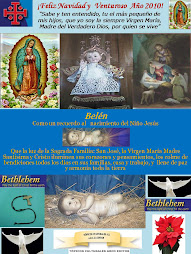
¡Feliz Navidad y Venturoso Año Nuevo 2010!
Acróstico
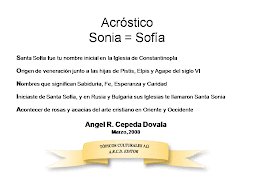
Sonia = Sofía
¡Feliz Pascua 2009!

Pascua.arcd
Pascua 2008

¡Felices Pascuas de Resurrección!
Navidad y Año Nuevo 2008

Feliz Navidad y Próspero Año 2008
Calendario 2013

Juan Pablo II
CALENDARIO 2013

Virgen María en el Arte
Calendario 2013

Benedicto XVI
Pascua 2013

Jesucristo El Buen Pastor
feliz día de las madres 2012

feliz día de las madres 2012
DICIEMBRE 2012

DICIEMBRE 2012
NOVIEMBRE 2012

NOVIEMBRE 2012
OCTUBRE 2012

Octubre 2012
SEPTIEMBRE 2012

SEPTIEMBRE 2012
AGOSTO 2012

AGOSTO 2012
JULIO 2012

JULIO 2012
JUNIO 2012

JUNIO 2012
MAYO 2012

MAYO 2012
ABRIL 2012

ABRIL 2012
MARZO 2012

marzo 2012
FEBRERO 2012

FEBRERO 2012
ENERO 2012

enero 2012
Nuestras Actitudes ante la Vida

Actitudes ante la Vida
SEASON OF CHRISTMAS

DECEMBER 25, 2012-JANUARY 6, 2013
¡FELIZ PASCUA 2012!

pascua 2012
Cátedra de San Pedro

St. Peter
14 de Febrero
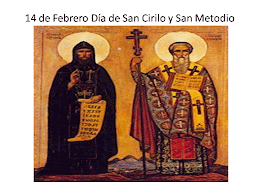
Día de San Cirilo y San Metodio
Conversión de San Pablo

Francesco Mazzola (1503-1540)
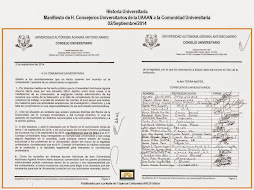
Manifiesto Universitario UAAAN

Documento Firmado y Recibido Enero 2013
Manifiesto Remoción Rector UAAAN

Documento, Enero 2013
Bendición

Feliz Navidad y Ventuoroso Año 2013
happy new year 2012

2012
Feliz Navidad 2011

Venturoso Año 2011
CUADRO 1. SÍNTESIS NEMOTÉCNICA UAAAN 2006-2012

CUADRO 2. SÍNTESIS NEMOTÉCNICA UAAAN 2006-2010

SHORT COMMUNICATION 1 ROGER BEHRA
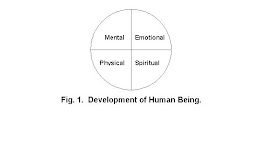
Fig. 1. Development of Human Being. (Roger Behra, 2007)
CEREMONIA PARA LA PAZ

INVITACIÓN ES.PE.RE.
Cuadro 1.Semillas germinadas y estadísticos descriptivos.

ARCD y JMCD
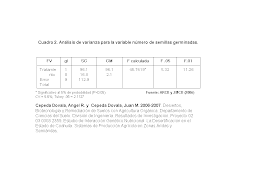
Cuadro 2. Análisis de varianza para la variable número de semillas germinadas.
Encíclicas de la Iglesia Católica
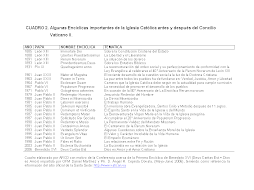
Algunas Encíclicas imortantes de la Iglesia Católica